

Japan’s shift toward tightening has added volatility to global markets, but structural support from U.S. growth, disinflation, and pending Fed easing is keeping risks contained. Unless Japanese yields or the yen move sharply, U.S. equities should navigate the turbulence and maintain a constructive setup into early 2026.
Japan’s Policy Shift Sends Global Markets Reeling
The U.S. stock market is under pressure this week as the Bank of Japan’s move on a possible December rate hike rattles markets worldwide. Japanese government bond yields have climbed to their highest levels since 2007, with the 10-year JGB approaching 1.93%, reflecting growing confidence that the BOJ will raise its policy rate to 0.75%. For a country that kept rates near zero for more than two decades, this shift represents a meaningful tightening in global financial conditions. Governor Ueda’s remarks that the BOJ will evaluate the “pros and cons” of a hike were interpreted as a signal of intent, immediately lifting global yields and tightening liquidity at the margin.
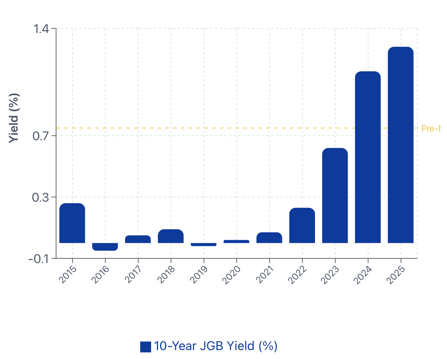
Impact of Rising Japanese Yields on U.S. Equities
Two mechanisms have driven the U.S. market’s reaction. First, higher Japanese yields reduce the relative attractiveness of U.S. assets, pushing the U.S. 10-year Treasury yield back above 4.1% and weighing on long-duration equities. Second, the prospect of a stronger yen has revived concerns about a partial unwind of yen-funded carry trades, a primary funding channel for global risk assets over the past decade. While the moves are far smaller than the August 2024 episode, the sensitivity of crypto, FX, and high-beta equities to these shifts shows how central Japanese liquidity remains to the broader market ecosystem.
Why a Disorderly Shock Remains Unlikely
For now, the risk of a sudden shock is small. Japanese investors are still purchasing foreign bonds, and lower hedging costs should keep their overseas flows steady. Japan’s policymakers have also emphasized that real rates remain negative, suggesting that even with a hike, financial conditions will remain accommodative. These factors help explain why global markets have experienced volatility, but not panic.
Supportive U.S. Macro Conditions Amid BOJ Tightening
In the U.S., the macro backdrop remains supportive. Disinflation is progressing, wage pressures are moderating, and markets are pricing in a high likelihood of a Fed rate cut next week. Equity sentiment is more fragile after a strong November performance, but underlying fundamentals—corporate earnings resilience, improving real incomes, and a potential Fed easing cycle—continue to anchor medium-term outlooks.
Near-Term Volatility, Constructive Outlook for 2026
In the coming weeks, U.S. equities are likely to stay volatile as markets assess the BOJ’s December 18–19 meeting and the Fed’s policy signals. However, unless Japanese yields break decisively above 2% or the yen appreciates in a disorderly way, any spillover into U.S. risk assets should remain contained. Overall, the U.S. macro backdrop—stabilizing growth, easing inflation, and gradually more accommodative policy—supports a constructive start heading into 2026.
Key Takeaways
-
Risks to watch: Japanese 10-year yields surpassing 2%, disorderly yen appreciation
-
U.S. equities outlook: Likely resilient amid global volatility
-
Macro drivers: Stabilizing growth, moderating inflation, potential Fed easing
EXPLORE MORE POSTS

AI Earnings, Higher Yields and the Election Outlook
Strong AI earnings are supporting selected businesses, while persistent...
Read More
From Market Data to Investment Decisions: What Quantitative Intelligence Really Means
Markets generate more information than any investor can reasonably process....
Read More
Higher Yields Put the Market’s Recovery to the Test
Rising Treasury yields are testing the durability of the equity-market recovery...
Read More
Introducing Quantel: A Clearer, More Intelligent Way to Manage Wealth
Wealth is becoming more complex. The tools used to understand and manage it...
Read More
Higher Interest Rates Test the Market, but Growth Signals Remain
Higher interest rates and Treasury yields are putting renewed pressure on...
Read More
AI + Human Judgment: The Future of Wealth Management?
AI is changing wealth management, but the more important question is not...
Read More
Oil Prices, Inflation and Higher Treasury Yields Keep Markets on Edge
Oil prices, persistent inflation and higher Treasury yields are increasing...
Read More
Why Wealth Management Needs More Than Periodic Portfolio Reviews
For many investors, wealth management still follows a familiar cycle: review...
Read More
AI Market Outlook: Strong Earnings, Market Rotation and Rate Risk
The AI market outlook remained constructive but increasingly selective this...
Read More
Why High Net Investor's Should Think Like Endowments
For many high-net-worth individuals (HNIs), building wealth is no longer the...
Read More
Macro Risk and Market Rotation: What It Means for Equities, Gold and Crypto
Markets are facing a renewed shift in leadership as Federal Reserve policy
Read More
What Do Institutional Investors Do Differently With Risk?

Rising Treasury Yields Reshape Markets
Rising Treasury yields are reshaping markets, putting pressure on equity...
Read More
AI vs. Manual Portfolio Monitoring
Portfolio monitoring has traditionally relied on human attention: reviewing...
Read More.png)
Inflation cools as AI infrastructure and memory rebound
Markets closed the week higher as cooling inflation offset early jitters over...
Read More
Why HNI's Should Think Like Endowments: A Smarter Approach to Long-Term Wealth Management
High-net-worth individuals (HNIs) often have something that many institutional...
Read More
From AI Spending to AI Earnings
The market’s message this week was constructive. Major indexes rebounded as...
Read More